Note
Go to the end to download the full example code.
Thermal noise inside conducting spheres
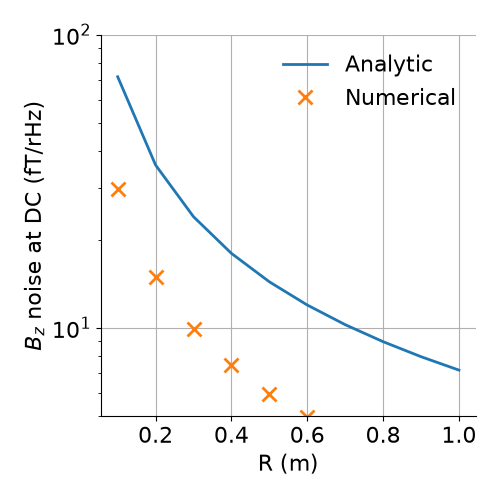
Compare thermal magnetic noise at the center of conducting spheres with an analytical result over a range of radii.
import pyvista as pv
from bfieldtools._example_plots import triangle_mesh

pv.set_plot_theme("document")

import numpy as np
import matplotlib.pyplot as plt
import trimesh
from bfieldtools.thermal_noise import (
    compute_current_modes,
    noise_covar,
    noise_var,
    visualize_current_modes,
)
from bfieldtools.mesh_magnetics import magnetic_field_coupling

from bfieldtools import resources


font = {"family": "normal", "weight": "normal", "size": 16}
plt.rc("font", **font)

# Fix the simulation parameters
d = 1e-3
sigma = 3.8e7
T = 293
kB = 1.38064852e-23
mu0 = 4 * np.pi * 1e-7
freqs = np.array((0,))


Nchunks = 8
quad_degree = 2
Unit sphere
Np = 10
radius = np.linspace(0.1, 1, Np)
fp = np.zeros((1, 3))

B = np.zeros((Np, 3))
for i in range(Np):
    mesh = trimesh.load(
        resources.files("bfieldtools", "example_meshes/unit_sphere.stl")
    )
    mesh.apply_scale(radius[i])
    B_coupling = magnetic_field_coupling(mesh, fp, analytic=True)
    vl = compute_current_modes(
        obj=mesh,
        T=T,
        resistivity=1 / sigma,
        thickness=d,
        mode="AC",
        return_eigenvals=False,
    )
    vl[:, 0] = np.zeros(vl[:, 0].shape)
    Btemp = noise_var(B_coupling, vl)
    B[i] = Btemp[:, :, 0]

plotter = scene = pv.Plotter(window_size=(800, 800))
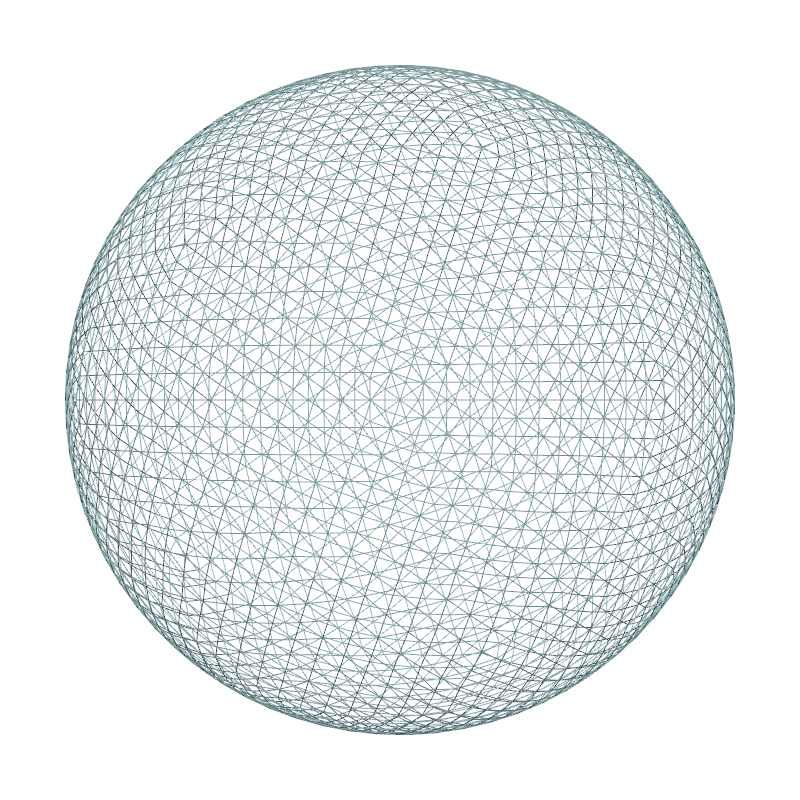
s = plotter.add_mesh(triangle_mesh(*mesh.vertices.T, mesh.faces), show_scalar_bar=False)
scene.view_xy(negative=True)
s.prop.style = "wireframe"
s.mapper.scalar_visibility = False
scene.camera.position = [0.0, 0.0, -5.530686305704514]
scene.camera.focal_point = [0.0, 0.0, 0.0]
scene.camera.view_angle = 30.0
scene.camera.up = [0.0, 1.0, 0.0]
scene.camera.clipping_range = [3.485379442647469, 8.118646600290083]
scene.render()
scene.camera.position = [0.0, 0.0, -4.570815128681416]
scene.camera.focal_point = [0.0, 0.0, 0.0]
scene.camera.view_angle = 30.0
scene.camera.up = [0.0, 1.0, 0.0]
scene.camera.clipping_range = [2.535106977394602, 7.1443773556116374]
scene.render()


Ban = mu0 * np.sqrt(2 * sigma * d * kB * T / (3 * np.pi * (radius) ** 2))

plt.figure(figsize=(5, 5))
plt.semilogy(radius, Ban * 1e15, linewidth=2, label="Analytic")
plt.semilogy(
    radius,
    np.sqrt(B[:, 2]) * 1e15,
    "x",
    markersize=10,
    markeredgewidth=2,
    label="Numerical",
)
plt.grid()
plt.gca().spines["right"].set_visible(False)
plt.gca().spines["top"].set_visible(False)
plt.legend(frameon=False)
plt.xlabel("R (m)")
plt.ylabel(r"$B_z$ noise at DC (fT/rHz)")
plt.ylim(5, 100)
plt.tight_layout()


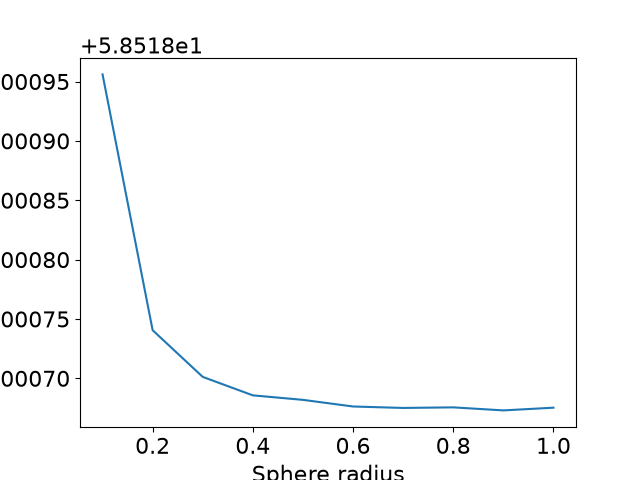
RE = np.abs((np.sqrt(B[:, 2]) - Ban)) / np.abs(Ban) * 100
plt.figure()
plt.plot(radius, RE)
plt.xlabel("Sphere radius")
plt.ylabel("Relative error (%)")

# Display the assembled scene (Sphinx-Gallery captures it during docs builds).
if "plotter" in globals() and not plotter._closed:
    plotter.show()
Computing magnetic field coupling matrix analytically, 2562 vertices by 1 target points... took 0.01 seconds.
No component count given, computing all components.
Calculating surface harmonics expansion...
Computing the resistance matrix...
Computing the inductance matrix...
Computing self-inductance matrix using rough quadrature (degree=2).              For higher accuracy, set quad_degree to 4 or more.
Estimating 24058 MiB required for 2562 by 2562 vertices...
Computing inductance matrix in 40 chunks (13960 MiB memory free),              when approx_far=True using more chunks is faster...
Computing triangle-coupling matrix
Inductance matrix computation took 51.81 seconds.
Closed mesh or Neumann BC, leaving out the constant component
Computing magnetic field coupling matrix analytically, 2562 vertices by 1 target points... took 0.01 seconds.
No component count given, computing all components.
Calculating surface harmonics expansion...
Computing the resistance matrix...
Computing the inductance matrix...
Computing self-inductance matrix using rough quadrature (degree=2).              For higher accuracy, set quad_degree to 4 or more.
Estimating 24058 MiB required for 2562 by 2562 vertices...
Computing inductance matrix in 40 chunks (13857 MiB memory free),              when approx_far=True using more chunks is faster...
Computing triangle-coupling matrix
Inductance matrix computation took 51.92 seconds.
Closed mesh or Neumann BC, leaving out the constant component
Computing magnetic field coupling matrix analytically, 2562 vertices by 1 target points... took 0.01 seconds.
No component count given, computing all components.
Calculating surface harmonics expansion...
Computing the resistance matrix...
Computing the inductance matrix...
Computing self-inductance matrix using rough quadrature (degree=2).              For higher accuracy, set quad_degree to 4 or more.
Estimating 24058 MiB required for 2562 by 2562 vertices...
Computing inductance matrix in 40 chunks (13862 MiB memory free),              when approx_far=True using more chunks is faster...
Computing triangle-coupling matrix
Inductance matrix computation took 51.90 seconds.
Closed mesh or Neumann BC, leaving out the constant component
Computing magnetic field coupling matrix analytically, 2562 vertices by 1 target points... took 0.01 seconds.
No component count given, computing all components.
Calculating surface harmonics expansion...
Computing the resistance matrix...
Computing the inductance matrix...
Computing self-inductance matrix using rough quadrature (degree=2).              For higher accuracy, set quad_degree to 4 or more.
Estimating 24058 MiB required for 2562 by 2562 vertices...
Computing inductance matrix in 40 chunks (13718 MiB memory free),              when approx_far=True using more chunks is faster...
Computing triangle-coupling matrix
Inductance matrix computation took 52.32 seconds.
Closed mesh or Neumann BC, leaving out the constant component
Computing magnetic field coupling matrix analytically, 2562 vertices by 1 target points... took 0.01 seconds.
No component count given, computing all components.
Calculating surface harmonics expansion...
Computing the resistance matrix...
Computing the inductance matrix...
Computing self-inductance matrix using rough quadrature (degree=2).              For higher accuracy, set quad_degree to 4 or more.
Estimating 24058 MiB required for 2562 by 2562 vertices...
Computing inductance matrix in 40 chunks (13631 MiB memory free),              when approx_far=True using more chunks is faster...
Computing triangle-coupling matrix
Inductance matrix computation took 52.38 seconds.
Closed mesh or Neumann BC, leaving out the constant component
Computing magnetic field coupling matrix analytically, 2562 vertices by 1 target points... took 0.01 seconds.
No component count given, computing all components.
Calculating surface harmonics expansion...
Computing the resistance matrix...
Computing the inductance matrix...
Computing self-inductance matrix using rough quadrature (degree=2).              For higher accuracy, set quad_degree to 4 or more.
Estimating 24058 MiB required for 2562 by 2562 vertices...
Computing inductance matrix in 40 chunks (13596 MiB memory free),              when approx_far=True using more chunks is faster...
Computing triangle-coupling matrix
Inductance matrix computation took 52.39 seconds.
Closed mesh or Neumann BC, leaving out the constant component
Computing magnetic field coupling matrix analytically, 2562 vertices by 1 target points... took 0.01 seconds.
No component count given, computing all components.
Calculating surface harmonics expansion...
Computing the resistance matrix...
Computing the inductance matrix...
Computing self-inductance matrix using rough quadrature (degree=2).              For higher accuracy, set quad_degree to 4 or more.
Estimating 24058 MiB required for 2562 by 2562 vertices...
Computing inductance matrix in 40 chunks (13663 MiB memory free),              when approx_far=True using more chunks is faster...
Computing triangle-coupling matrix
Inductance matrix computation took 52.13 seconds.
Closed mesh or Neumann BC, leaving out the constant component
Computing magnetic field coupling matrix analytically, 2562 vertices by 1 target points... took 0.01 seconds.
No component count given, computing all components.
Calculating surface harmonics expansion...
Computing the resistance matrix...
Computing the inductance matrix...
Computing self-inductance matrix using rough quadrature (degree=2).              For higher accuracy, set quad_degree to 4 or more.
Estimating 24058 MiB required for 2562 by 2562 vertices...
Computing inductance matrix in 40 chunks (13490 MiB memory free),              when approx_far=True using more chunks is faster...
Computing triangle-coupling matrix
Inductance matrix computation took 52.05 seconds.
Closed mesh or Neumann BC, leaving out the constant component
Computing magnetic field coupling matrix analytically, 2562 vertices by 1 target points... took 0.01 seconds.
No component count given, computing all components.
Calculating surface harmonics expansion...
Computing the resistance matrix...
Computing the inductance matrix...
Computing self-inductance matrix using rough quadrature (degree=2).              For higher accuracy, set quad_degree to 4 or more.
Estimating 24058 MiB required for 2562 by 2562 vertices...
Computing inductance matrix in 40 chunks (13445 MiB memory free),              when approx_far=True using more chunks is faster...
Computing triangle-coupling matrix
Inductance matrix computation took 51.96 seconds.
Closed mesh or Neumann BC, leaving out the constant component
Computing magnetic field coupling matrix analytically, 2562 vertices by 1 target points... took 0.01 seconds.
No component count given, computing all components.
Calculating surface harmonics expansion...
Computing the resistance matrix...
Computing the inductance matrix...
Computing self-inductance matrix using rough quadrature (degree=2).              For higher accuracy, set quad_degree to 4 or more.
Estimating 24058 MiB required for 2562 by 2562 vertices...
Computing inductance matrix in 40 chunks (13391 MiB memory free),              when approx_far=True using more chunks is faster...
Computing triangle-coupling matrix
Inductance matrix computation took 52.17 seconds.
Closed mesh or Neumann BC, leaving out the constant component
findfont: Font family 'normal' not found.
findfont: Font family 'normal' not found.
findfont: Font family 'normal' not found.
findfont: Font family 'normal' not found.
findfont: Font family 'normal' not found.
findfont: Font family 'normal' not found.
findfont: Font family 'normal' not found.
findfont: Font family 'normal' not found.
findfont: Font family 'normal' not found.
findfont: Font family 'normal' not found.
findfont: Font family 'normal' not found.
findfont: Font family 'normal' not found.
findfont: Font family 'normal' not found.
findfont: Font family 'normal' not found.
findfont: Font family 'normal' not found.
findfont: Font family 'normal' not found.
findfont: Font family 'normal' not found.
findfont: Font family 'normal' not found.
findfont: Font family 'normal' not found.
findfont: Font family 'normal' not found.
findfont: Font family 'normal' not found.
findfont: Font family 'normal' not found.
findfont: Font family 'normal' not found.
findfont: Font family 'normal' not found.
findfont: Font family 'normal' not found.
findfont: Font family 'normal' not found.
findfont: Font family 'normal' not found.
Total running time of the script: (9 minutes 23.466 seconds)