Note
Go to the end to download the full example code.
Biplanar coil design
First example in the paper, showing a basic biplanar coil producing homogeneous field in a target region between the two coil planes.
import pyvista as pv
from bfieldtools._example_plots import point_cloud, set_view

pv.set_plot_theme("document")

PLOT = True
SAVE_FIGURES = False

SAVE_DIR = "./Biplanar coil/"


import numpy as np
import trimesh

from bfieldtools.mesh_conductor import MeshConductor
from bfieldtools.coil_optimize import optimize_streamfunctions
from bfieldtools.contour import scalar_contour
from bfieldtools.viz import plot_3d_current_loops
from bfieldtools.utils import load_example_mesh, combine_meshes


# Set unit, e.g. meter or millimeter.
# This doesn't matter, the problem is scale-invariant
scaling_factor = 1


# Load simple plane mesh that is centered on the origin
planemesh = load_example_mesh("10x10_plane_hires")


# Specify coil plane geometry
center_offset = np.array([0, 0, 0]) * scaling_factor
standoff = np.array([0, 5, 0]) * scaling_factor

# Create coil plane pairs
coil_plus = trimesh.Trimesh(
    planemesh.vertices + center_offset + standoff, planemesh.faces, process=False
)

coil_minus = trimesh.Trimesh(
    planemesh.vertices + center_offset - standoff, planemesh.faces, process=False
)

joined_planes = combine_meshes((coil_plus, coil_minus))

joined_planes = joined_planes.subdivide()

# Create mesh class object
coil = MeshConductor(
    verts=joined_planes.vertices,
    tris=joined_planes.faces,
    fix_normals=True,
    basis_name="suh",
    N_suh=100,
)
Calculating surface harmonics expansion...
Computing the laplacian matrix...
Computing the mass matrix...
Set up target and stray field points
# Here, the target points are on a volumetric grid within a sphere

center = np.array([0, 0, 0]) * scaling_factor

sidelength = 2 * scaling_factor
n = 8
xx = np.linspace(-sidelength / 2, sidelength / 2, n)
yy = np.linspace(-sidelength / 2, sidelength / 2, n)
zz = np.linspace(-sidelength / 2, sidelength / 2, n)
X, Y, Z = np.meshgrid(xx, yy, zz, indexing="ij")

x = X.ravel()
y = Y.ravel()
z = Z.ravel()

target_points = np.array([x, y, z]).T

# Turn cube into sphere by rejecting points "in the corners"
target_points = (
    target_points[np.linalg.norm(target_points, axis=1) < sidelength / 2] + center
)


#    #Here, the stray field points are on a spherical surface
stray_radius = 20 * scaling_factor

stray_points_mesh = trimesh.creation.icosphere(subdivisions=3, radius=stray_radius)
stray_points = stray_points_mesh.vertices + center

n_stray_points = len(stray_points)
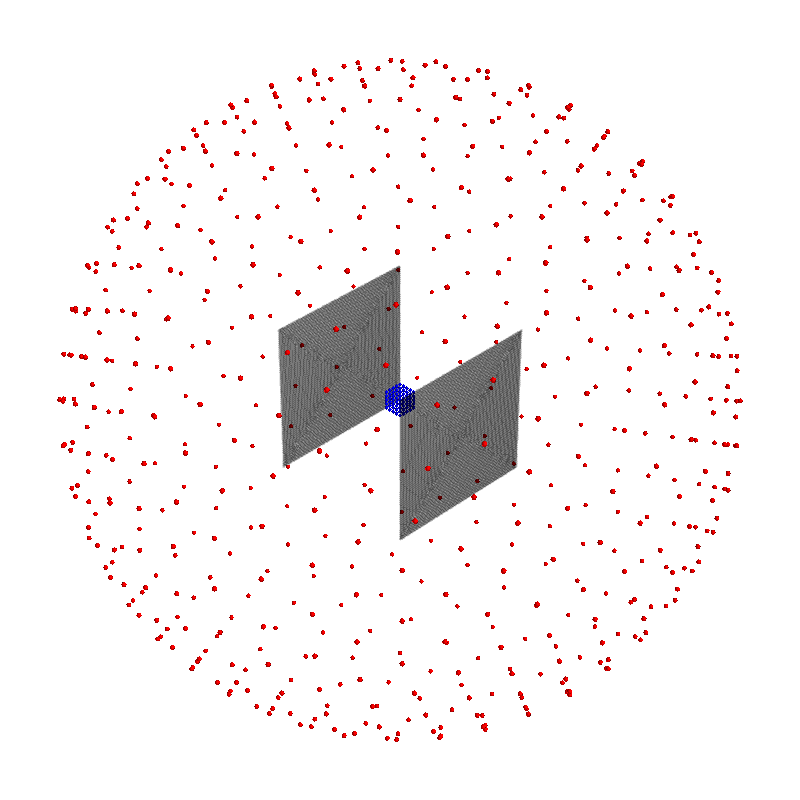
Plot geometry
if PLOT:
    plotter = f = pv.Plotter(window_size=(800, 800))
    plotter = coil.plot_mesh(style="wireframe", opacity=0.1, color=(0, 0, 0), figure=f)
    plotter = coil.plot_mesh(style="surface", opacity=0.1, color=(0, 0, 0), figure=f)
    plotter.add_mesh(
        point_cloud(*target_points.T).glyph(
            scale=False, geom=pv.Sphere(radius=0.05 / 2)
        ),
        color=(0, 0, 1),
        show_scalar_bar=False,
    )
    plotter.add_mesh(
        point_cloud(*stray_points.T).glyph(scale=False, geom=pv.Sphere(radius=0.3 / 2)),
        color=(1, 0, 0),
        show_scalar_bar=False,
    )
    f.view_isometric()
    f.camera.zoom(1.5)
    if SAVE_FIGURES:
        f.screenshot(SAVE_DIR + "biplanar_geometry.png", scale=4)
        plotter.close()
/home/runner/work/bfieldtools.github.io/bfieldtools.github.io/examples/publication_software/pub_biplanar_coil_design.py:108: UserWarning: No vector-like data to use for orient. orient will be set to False.
  point_cloud(*target_points.T).glyph(
/home/runner/work/bfieldtools.github.io/bfieldtools.github.io/examples/publication_software/pub_biplanar_coil_design.py:115: UserWarning: No vector-like data to use for orient. orient will be set to False.
  point_cloud(*stray_points.T).glyph(scale=False, geom=pv.Sphere(radius=0.3 / 2)),
Create bfield specifications used when optimizing the coil geometry
# The absolute target field amplitude is not of importance,
# and it is scaled to match the C matrix in the optimization function

target_field = np.zeros(target_points.shape)
target_field[:, 0] += 1  # Homogeneous field on X-axis


target_spec = {
    "coupling": coil.B_coupling(target_points),
    "abs_error": 0.005,
    "target": target_field,
}
stray_spec = {
    "coupling": coil.B_coupling(stray_points),
    "abs_error": 0.01,
    "target": np.zeros((n_stray_points, 3)),
}

bfield_specification = [target_spec, stray_spec]
Computing magnetic field coupling matrix, 12442 vertices by 160 target points... took 1.34 seconds.
Computing magnetic field coupling matrix, 12442 vertices by 642 target points... took 5.32 seconds.
Run QP solver
coil.s, prob = optimize_streamfunctions(
    coil,
    [target_spec, stray_spec],
    objective=(0, 1),
    solver="CLARABEL",
)
Computing the resistance matrix...
Passing problem to solver...
===============================================================================
                                     CVXPY
                                     v1.9.2
===============================================================================
-------------------------------------------------------------------------------
                                  Compilation
-------------------------------------------------------------------------------
-------------------------------------------------------------------------------
                                Numerical solver
-------------------------------------------------------------------------------
-------------------------------------------------------------
           Clarabel.rs v0.11.1  -  Clever Acronym

                   (c) Paul Goulart
                University of Oxford, 2022
-------------------------------------------------------------

problem:
  variables     = 100
  constraints   = 4812
  nnz(P)        = 5045
  nnz(A)        = 481200
  cones (total) = 1
    : Nonnegative = 1,  numel = 4812

settings:
  linear algebra: direct / faer, precision: 64 bit (4 threads)
  max iter = 200, time limit = Inf,  max step = 0.990
  tol_feas = 1.0e-8, tol_gap_abs = 1.0e-8, tol_gap_rel = 1.0e-8,
  static reg : on, ϵ1 = 1.0e-8, ϵ2 = 4.9e-32
  dynamic reg: on, ϵ = 1.0e-13, δ = 2.0e-7
  iter refine: on, reltol = 1.0e-13, abstol = 1.0e-12,
               max iter = 10, stop ratio = 5.0
  equilibrate: on, min_scale = 1.0e-4, max_scale = 1.0e4
               max iter = 10

iter    pcost        dcost       gap       pres      dres      k/t        μ       step
---------------------------------------------------------------------------------------------
  0  +1.4699e+02  -3.1572e+05  2.15e+03  2.33e-01  9.06e-18  1.00e+00  1.17e+02   ------
  1  +2.7934e+02  -9.9609e+04  3.58e+02  7.90e-02  5.12e-17  7.11e+00  4.85e+01  6.64e-01
  2  +5.8415e+02  -9.4337e+04  1.62e+02  6.00e-02  4.29e-17  1.03e+01  4.50e+01  2.18e-01
  3  +1.7353e+03  -2.1981e+04  1.37e+01  9.22e-03  8.52e-17  3.97e+00  1.24e+01  8.00e-01
  4  +2.0412e+03  -2.1671e+04  1.16e+01  8.59e-03  2.10e-17  4.20e+00  1.22e+01  9.15e-02
  5  +2.3066e+03  -6.5609e+03  3.84e+00  3.03e-03  3.96e-17  1.73e+00  4.72e+00  6.84e-01
  6  +2.5634e+03  -2.9345e+03  2.14e+00  1.79e-03  2.74e-17  1.25e+00  2.88e+00  6.65e-01
  7  +2.4822e+03  -4.0640e+03  2.64e+00  2.16e-03  1.17e-16  1.71e+00  2.88e+00  2.98e-02
  8  +8.9087e+03  -1.0046e+04  2.13e+00  1.57e-03  7.56e-16  5.46e+00  1.13e+00  9.33e-01
  9  +7.8852e+03  -1.0787e+04  2.37e+00  1.59e-03  4.37e-16  5.81e+00  1.11e+00  1.62e-01
 10  +1.3900e+04  +9.0757e+03  5.32e-01  1.85e-04  9.24e-17  1.47e+00  1.67e-01  8.80e-01
 11  +1.5456e+04  +1.4413e+04  7.23e-02  3.40e-05  2.76e-17  4.29e-01  3.24e-02  9.90e-01
 12  +1.6291e+04  +1.6142e+04  9.24e-03  3.91e-06  7.31e-17  5.64e-02  4.06e-03  8.88e-01
 13  +1.6313e+04  +1.6197e+04  7.17e-03  3.03e-06  1.15e-16  4.44e-02  3.15e-03  4.38e-01
 14  +1.6402e+04  +1.6398e+04  2.14e-04  8.40e-08  2.53e-16  1.29e-03  9.12e-05  9.72e-01
 15  +1.6404e+04  +1.6404e+04  2.61e-06  1.12e-09  1.42e-16  1.57e-05  1.11e-06  9.89e-01
 16  +1.6404e+04  +1.6404e+04  3.00e-08  5.85e-11  2.48e-16  1.80e-07  1.27e-08  9.89e-01
 17  +1.6404e+04  +1.6404e+04  3.09e-10  6.54e-12  3.25e-17  1.84e-09  1.30e-10  9.90e-01
---------------------------------------------------------------------------------------------
Terminated with status = Solved
solve time = 2.722779804s
-------------------------------------------------------------------------------
                                    Summary
-------------------------------------------------------------------------------
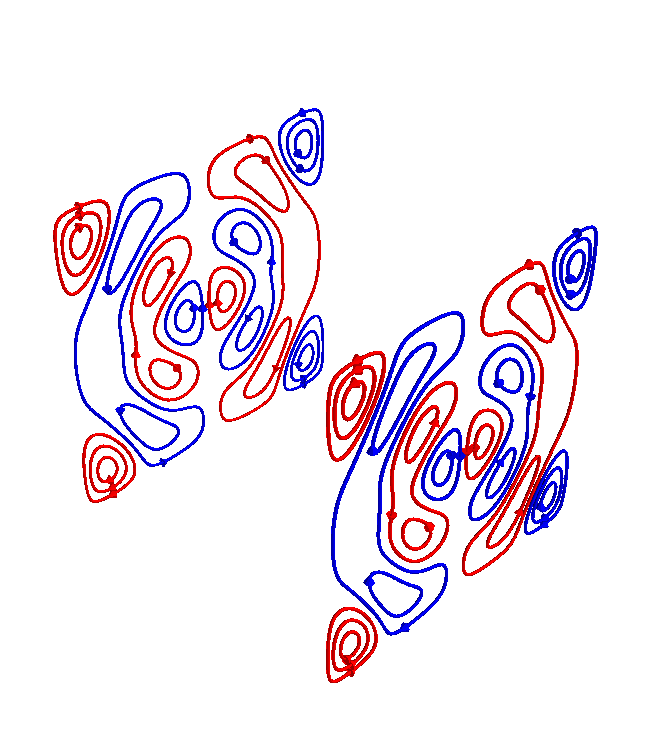
Plot coil windings and target points
N_contours = 6

loops = scalar_contour(coil.mesh, coil.s.vert, N_contours=N_contours)

if PLOT:
    plotter = f = pv.Plotter(window_size=(650, 750))
    plotter.clear()
    plotter = plot_3d_current_loops(loops, colors="auto", figure=f)
    f.view_isometric()
    if SAVE_FIGURES:
        f.screenshot(SAVE_DIR + "biplanar_loops.png", scale=4)
        plotter.close()
Processing contour, value: -349520255.04506946
Processing contour, value: -209751115.80495754
Processing contour, value: -69981976.56484568
Processing contour, value: 69787162.67526627
Processing contour, value: 209556301.9153781
Processing contour, value: 349325441.15549004
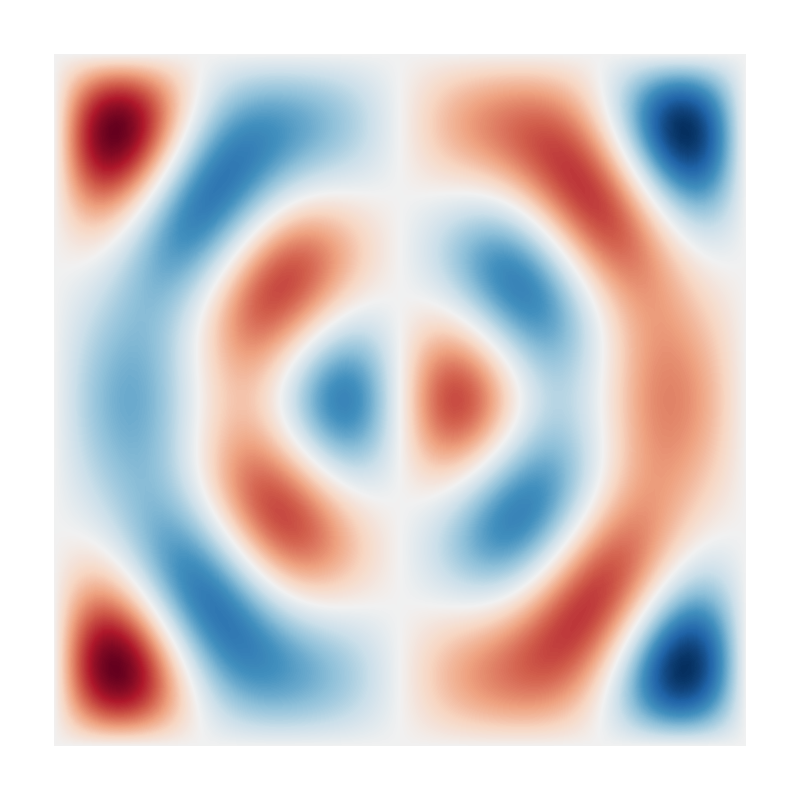
Plot continuous stream function
if PLOT:
    from bfieldtools.viz import plot_data_on_vertices

    plotter = f = pv.Plotter(window_size=(800, 800))
    plotter.clear()
    plotter = plot_data_on_vertices(coil.mesh, coil.s.vert, figure=f, ncolors=256)
    f.camera.parallel_projection = 1
    set_view(plotter, 90, 90)
    f.camera.zoom(1.5)
    if SAVE_FIGURES:
        f.screenshot(SAVE_DIR + "biplanar_streamfunction.png", scale=4)
        plotter.close()

# Display the assembled scene (Sphinx-Gallery captures it during docs builds).
if "plotter" in globals() and not plotter._closed:
    plotter.show()
Total running time of the script: (0 minutes 24.262 seconds)