Note
Go to the end to download the full example code.
Compare SUH and SPH basis functions for the magnetic scalar potential
import pyvista as pv

pv.set_plot_theme("document")


import numpy as np
import matplotlib.pyplot as plt
import trimesh
from bfieldtools import resources


from bfieldtools.mesh_magnetics import magnetic_field_coupling
from bfieldtools.mesh_magnetics import magnetic_field_coupling_analytic
from bfieldtools.mesh_magnetics import scalar_potential_coupling
from bfieldtools.sphtools import compute_sphcoeffs_mesh, basis_fields
from bfieldtools.suhtools import SuhBasis
from bfieldtools.utils import load_example_mesh


mesh = load_example_mesh("bunny_repaired", process=True)

mesh.vertices -= mesh.vertices.mean(axis=0)

mesh_field = mesh.copy()
mesh_field.vertices += 0.001 * mesh_field.vertex_normals
# mesh_field = trimesh.smoothing.filter_laplacian(mesh_field, iterations=1)

# Ca, Cb = basis_fields(mesh_field.vertices, 4)

# bsuh = SuhBasis(mesh, 25)
# Csuh = magnetic_field_coupling_analytic(mesh, mesh_field.vertices) @ bsuh.basis
- def plot_basis_fields(C, comps):
d = 0.17 i = 0 j = 0 for n in comps:
p = 1.05 * mesh_field.vertices.copy() p2 = mesh_field.vertices.copy() # p[:,1] -= i*d # p2[:,1] -= i*d p[:, 0] += i * d p2[:, 0] += i * d m = np.max(np.linalg.norm(C[:, :, n], axis=0))
) # m = np.max(abs((C[:,:,n].T*mesh_field.vertex_normals.T).sum(axis=0))) # scalars=(C[:,:,n].T*mesh_field.vertex_normals.T).sum(axis=0), # colormap=’seismic’, vmin=-m, vmax=m, opacity=0.7) m = np.max(abs((C[:, :, n].T * mesh_field.vertex_normals.T).sum(axis=0)))
*p2.T, mesh.faces, scalars=(C[:, :, n].T * mesh_field.vertex_normals.T).sum(axis=0), colormap=”bwr”, vmin=-m, vmax=m
) i += 1
# comps = [0, 4, 10, 15]
# plot_basis_fields(Ca, comps)


# plot_basis_fields(Csuh, comps)
from bfieldtools.mesh_magnetics import scalar_potential_coupling
from bfieldtools.sphtools import basis_potentials

scaling_factor = 0.02
# Load simple plane mesh that is centered on the origin
plane = load_example_mesh("10x10_plane_hires")
plane.apply_scale(scaling_factor)
# Rotate to x-plane
t = np.eye(4)
t[1:3, 1:3] = np.array([[0, 1], [-1, 0]])
plane.apply_transform(t)
# Subdivide face close to the mesh
from trimesh.proximity import signed_distance

dd = signed_distance(mesh, plane.triangles_center)
plane = plane.subdivide(np.flatnonzero(abs(dd) < 0.005))
dd = signed_distance(mesh, plane.triangles_center)
plane = plane.subdivide(np.flatnonzero(abs(dd) < 0.002))

UB = scalar_potential_coupling(mesh, plane.vertices, multiply_coeff=False)
mask = np.sum(UB, axis=1)
mask = mask > -0.5

Ua, Ub = basis_potentials(plane.vertices, 6)
bsuh = SuhBasis(mesh, 48)
# UB = scalar_potential_coupling(mesh, plane.vertices)
Usuh = UB @ bsuh.basis

sphere = trimesh.creation.icosphere(radius=0.02)
Ua_mesh, Ub_mesh = basis_potentials(sphere.vertices, 5)
UB_mesh = scalar_potential_coupling(mesh, mesh_field.vertices)
Usuh_mesh = UB_mesh @ bsuh.basis
Computing scalar potential coupling matrix, 2503 vertices by 3562 target points... took 8.51 seconds.
Calculating surface harmonics expansion...
Computing the laplacian matrix...
Computing the mass matrix...
Closed mesh or Neumann BC, leaving out the constant component
Computing scalar potential coupling matrix, 2503 vertices by 2503 target points... took 5.97 seconds.
comps = [0, 5, 13, 17]
d = 0.22
from bfieldtools.viz import plot_data_on_vertices
from bfieldtools.viz import plot_mesh

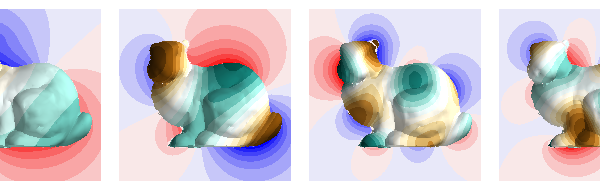
# Plot suh
i = 0
plotter = fig = pv.Plotter(window_size=(600, 190))
for n in comps:
    p = plane.copy()
    p.vertices[:, 0] += i * d
    p2 = mesh_field.copy()
    p2.vertices[:, 0] += i * d
    scalars = Usuh[:, n].copy()
    scalars[~mask] = 0
    scalars2 = bsuh.basis[:, n]
    m = np.max(abs(scalars))
    m2 = np.max(abs(scalars2))
    plotter = plot_data_on_vertices(
        p, scalars, figure=fig, ncolors=15, vmax=m, colormap="bwr"
    )
    plotter = plot_data_on_vertices(
        p2, scalars2, figure=fig, ncolors=15, vmax=m2, colormap="BrBG"
    )
    i += 1
fig.parallel_projection = True
fig.view_xy()
fig.camera.parallel_scale = 0.11
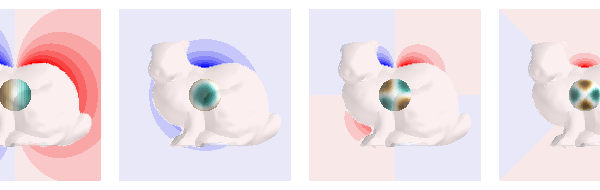
i = 0
plotter = fig = pv.Plotter(window_size=(600, 190))
for n in comps:
    p = plane.copy()
    p.vertices[:, 0] += i * d
    p2 = sphere.copy()
    p2.vertices[:, 0] += i * d
    scalars = Ua[:, n].copy()
    scalars[~mask] = 0
    scalars2 = Ua_mesh[:, n]
    m = np.max(abs(scalars))
    m2 = np.max(abs(scalars2))
    plotter = plot_data_on_vertices(
        p, scalars, figure=fig, ncolors=15, vmax=m, colormap="bwr"
    )
    plotter = plot_data_on_vertices(
        p2, scalars2, figure=fig, ncolors=15, vmax=m2, colormap="BrBG"
    )
    p3 = mesh.copy()
    p3.vertices[:, 0] += i * d
    plotter = plot_mesh(p3, opacity=0.3, figure=fig)
    i += 1
fig.parallel_projection = True
fig.view_xy()
fig.camera.parallel_scale = 0.11

# Display the assembled scene (Sphinx-Gallery captures it during docs builds).
if "plotter" in globals() and not plotter._closed:
    plotter.show()
Total running time of the script: (0 minutes 22.750 seconds)